Rachel Whiteread
Whiteread (born 1963) is an English artist who produces sculptures, which primarily take the form of casts using different materials. She uses the negative space surrounding an onject to create her work.
She has been casting these so-called “negatives spaces” for three decades. The original idea comes from the US artist Bruce Nauman, whose A Cast of the Space Under My Chair (1965-8) spells out the method, if not the varying effects. Whiteread has gone further, casting the innards of a hot-water bottle and a mattress; the undersides of a table, the space behind a fireplace or surrounding a bath. Her works run from the modest to the monumental – most famously the interior of an entire house – cast in plaster, resin, concrete or rubber, occasionally in metal (mundane) and lately in papier-mache (actively hideous). Everything she makes balances the possibility of poetry against the risk of banality.
This is not necessarily intrinsic to the objects themselves. Take the beautiful piece Torso that opens this enormous exhibition. Cast in plaster, from a hot-water bottle, this little thing lies on its back, vulnerable, pale and turning slightly, as if troubled in sleep. Whiteread made this sculpture in 1988, and it remains unsurpassed. One can say this because the artist has been casting hot water bottles ever since. There are nine more in this show – in clear resin, yellow wax, flesh-pink plaster, each differently swollen or flexed. Not one has the same potency or charge.
Whiteread (born 1963) is an English artist who produces sculptures, which primarily take the form of casts using different materials. She uses the negative space surrounding an onject to create her work.
She has been casting these so-called “negatives spaces” for three decades. The original idea comes from the US artist Bruce Nauman, whose A Cast of the Space Under My Chair (1965-8) spells out the method, if not the varying effects. Whiteread has gone further, casting the innards of a hot-water bottle and a mattress; the undersides of a table, the space behind a fireplace or surrounding a bath. Her works run from the modest to the monumental – most famously the interior of an entire house – cast in plaster, resin, concrete or rubber, occasionally in metal (mundane) and lately in papier-mache (actively hideous). Everything she makes balances the possibility of poetry against the risk of banality.
This is not necessarily intrinsic to the objects themselves. Take the beautiful piece Torso that opens this enormous exhibition. Cast in plaster, from a hot-water bottle, this little thing lies on its back, vulnerable, pale and turning slightly, as if troubled in sleep. Whiteread made this sculpture in 1988, and it remains unsurpassed. One can say this because the artist has been casting hot water bottles ever since. There are nine more in this show – in clear resin, yellow wax, flesh-pink plaster, each differently swollen or flexed. Not one has the same potency or charge.
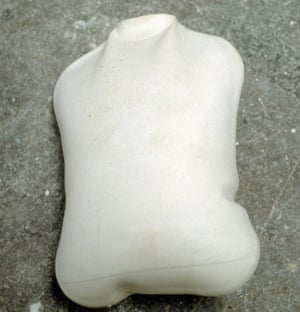 |
| Torso, 1988. Photograph: © Rachel Whiteread That whiteness depicted in almost all of her works has become Whiteread’s own trademark somewhat. It diverts attention from the original object, emphasising the status of these works as sculptures. A cardboard box, a bath, a sink – cast in white plaster or concrete, all lose their individuality to become universal forms, and perhaps even quasi-abstract. There is a work here called Untitled (White Slab), and its provenance is completely unclear. It looks far more like a work of American minimalism than any kind of household object. Along with the whiteness and diversion from the original object, Whiteread uses replication that borders on repetition; facsimile, no matter in what medium, colour, configuration or scale, doesn’t always lead to transformation. But when these elements are in perfect alignment, she is a poet of the past.
Her work has inspired a thread of my work from the sculpture workshops, I have collected bottles found within the area around the university and filled the negative space inside the bottles with plaster. The casts that are formed within these crushed, crinkled and discarded bottles resist categorisation. By taking these objects out of their environment and creating another object from them it can be experienced out of context. These casts will be placed back into an environment as a visual image of the devastation pollution is causing, people see plastic waste as mundane and part of the everyday but when the materiality of the object is changed it becomes more significant.
Jan Albers Albers conquers new territory for art, demonstrating that it is, even after modernism and postmodernism, still possible and necessary to create works of art that are new and unlike anything we have seen before. It is not by accident that his art moves nimbly between Nelson Mandela and Ellsworth Kelly: this unusual tension between political engagement and spiritual yearning is what renders Albers’s oeuvre so fascinating and persuasive. His works show that artistic invention and social relevance, far from being mutually exclusive, may in fact sustain each other. There is no conceptual or fashionable expediency in this recycling urge but simply Albers work occasionally converts the low-brow and discarded – in a spirit closer to Dada perhaps than it is to a mindful recycling ethos. Stephen Berg has described…“the entire picture is actually a permanent construction site alternating between destruction and repair.” This altercation between making and unmaking, harmony and disharmony runs through all of his work. One gets the sense that Albers views most material as potentially “uncooperative” and unruly – something to be tamed or at the very least bridled. Albers work embraces a range of connections between architecture and the environment, his works are a consolation amongst the playfulness of manipulated material and the ability to test, strain and transform. The abstract nature of the finished product is what intrigues me, as I try and capture the ever changing within my own practise. This in a way is a difficult challenge as the concept I have behind my physical work is non-the-less real. Albers manages to bridge the gap between this which is something I can take from this research and implement within my own. 
Jan Albers, highOnlight 2015, bronze 60 x 40 x 20 cm
|
Comments
Post a Comment