A pioneer of environmental art and a representative of the European development of Land Art or Art in Nature, Alio Bonanno is a site-specific, outdoor installation artist who has been creating large-scale sculptures within selected, natural environments for the past 35 years. The symbiosis between art, nature and ecology is an important aspect of his work, as is his role as artist, consultant and lecturer. In 1985 his Sound Year Installation at the Mir Museum in Barcelona, Spain, a collaboration with Danish composer Gunner Muller Pedersen, was seen as a breakthrough in environmental art. Mir Museum produced a film of the Sound Year Project. It was on his initiative and with him as chairman that TICKON, Tranekar International Centre for Art and Nature was created on the Danish Island of Langeland in 1990. In 2004 he created Himmelh j, a sculpture landscape containing four major site specific works. In 2000 Lars R. Jensen and Torben K. Madsen with support from the Danish Film Institute and Danish Video workshop produced "Fragments of a Life", a 45 min. documentary film on Alfio Bonanno and his work. This Film has been shown on Danish National Television and at Film Festivals in Denmark (where it was awarded a prize), in Germany and at the Environmental Film Festival in Washington, DC, USA. In 2005 he was awarded Hydro Texaco`s "Friend of the Tree" Prize. In June 2006, Alfio Bonanno was awarded on behalf of the Italian President Carlo Azeglio Ciampi, The Order OSSI, Ordine della Stella della Solidariet Italiana. Since the late 1970's he has worked in many countries with and in natural and urban landscapes with site specific projects both with large structures of natures own materials and with conceptual acts.
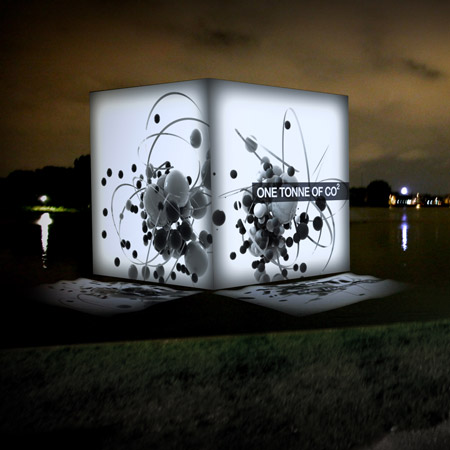
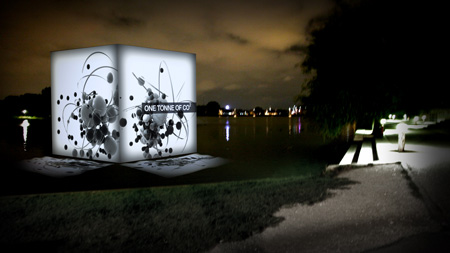
Artist Alfio Bonanno and architect Christophe Cornubert will present an installation representing a metric ton of carbon dioxide in Copenhagen next month, while the city hosts the UN Framework Convention on Climate Change (UNFCCC).
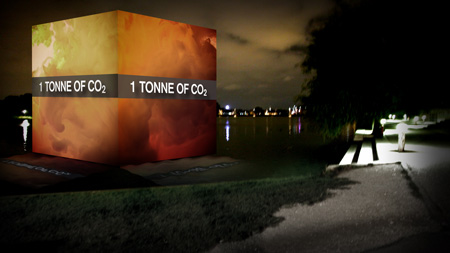
The cube, measuring 27 feet by 27 feet by 27 feet, represents the monthly carbon footprint of the average person, or the amount of carbon produced by each US citizen in two weeks.
Here's some info about the project:
--
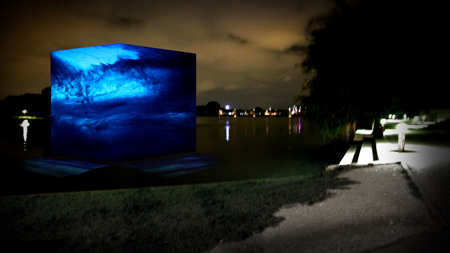
On December 7th, world leaders committed to battle climate change will gather in Copenhagen at the UN Framework Convention on Climate Change (UNFCC). Through the use of art, architecture and pioneering technology, the CO2 CUBES will show leaders and citizens alike, the physical manifestation of one person's carbon footprint.
Measuring 27' x 27' x 27', the CO2 CUBES represent one metric ton of carbon dioxide. The structure mirrors the carbon footprint that an average citizen emits during one month; this same amount is produced by a U.S. citizen in only two weeks.
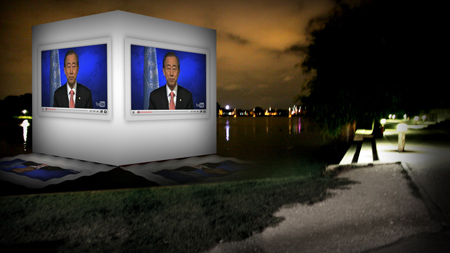
The Cubes, created by artist Alfio Bonanno and LA-based architect Christophe Cornubert, a Reitveld Architecture Prize recipient, will be situated near St. Jorgens Lake and the Tycho Brache Planetarium. In addition, the interactive media delivery system features multiple screens programmed into a 24-hour cycle. Developed by innovators Obscura Digital, the system incorporates video streams, real-time data, and practical solutions that will help to slow climate change.
With international leaders, UN officials, organizations and media in attendance, the Convention on Climate Change has a dual objective of inspiring policy makers and global citizens. It is estimated that the CO2 CUBES will reach an international audience of 420 million. Content will be distributed via digital & broadcast media outlets as well as through social networking sites and partner websites.
Cold Dark Matter: An Exploded View is the restored contents of a garden shed exploded by the British Army at the request of the artist Cornelia Parker. The surviving pieces have been used by Parker to create an installation suspended from the ceiling as if held mid-explosion. Lit by a single lightbulb the fragments cast dramatic shadows on the gallery’s walls. In an interview with Tate curator Michaela Parkin, Parker suggested that an explosion was something she had wanted to do for a long time. To her, an explosion is an ‘archetypal’ image, familiar to us from childhood to adult life: Somehow the idea and imminence of the ‘explosion’ in society seemed such an iconic thing. You were being constantly bombarded with its imagery, from the violence of the comic strip, through action films, in documentaries about Super Novas and the Big Bang, and least of all on the news in never ending reports of war. Parker liked the idea of something that happened...
Claire Bishop’s short paper begins with a curious quote from Dan Graham: “All artists are alike. They dream of doing something that’s more social, more critical, and more real than art” (60) . A brazen comment, this generalisation gives Bishop’s discussion a provocative start. It also anticipates her assumption that all “real” art is necessarily concerned with aesthetics. This helps to explain her interest in discussing “the social turn” as Art—or, more accurately, a lack thereof . After briefly describing both the recent proliferation of publicly engaged art practices and their value as therapy for repairing the social bond , Bishop maps prevailing perceptions of this art as polarized. There are the “non-believers,” the aesthetes who dismiss the art as uninteresting, and there are “the believers” the zealots, the activists who, according to Bishop, “…reject aesthetic questions a s synonymous with the market and cultural hierarchy ” (61). Curiously, Bishop fails to identify a third ...
For this piece the initial artwork wasnt documented digitally by film or phtograph, i wanted to let the objects and the piece exist on their own within the space and allow the interactions and participation to happen without there being any sense that it is an art work. I feel like the results are completely different by just writing about the interactions as a reflection and a time lapse done in the simplest form by using text. I found that the audience were rather confused about the obejcts as they were so precariously placed and people are used being informed about the art works or public art pieces. Knowing this the first investigation of this project was a success, i was able to gather an understanding of how people would interact with my art work and how it would display my concept. After this investigation I do feel as though i need to reconsider how i document these installations, I still want them to be discrete and have a sense of the unknowing but also wo...
Comments
Post a Comment